Showing posts with label LGBT. Show all posts

Monday, 12 September 2011

Bisexual Revolution: Documentary Review


Co-directed and written by Laure Michel and Eric Wastiaux, La bisexualité : tout un art?  (titled Bisexual Revolution for the english-speaking market) is a 2010 documentary about bisexuality, its culture, its cultural manifestations, taboos, myths, realities, and perceptions.  It goes through a series of interviews in Paris, Berlin, New York, San Francisco, Montreal artists, writers and psychologists, about the subject in point.

Although it all goes in an intellectual and artistic discussion format, it's not the kind of documentary that goes down to really interact with "normal" people in their lives, apart from a few street-interviews.  That of course doesn't make it less valuable or boring, but a very traditional documentary approach in that way.
It covers a lot of topics and issues about bisexuality and its different cultural, artistic and social manifestations. As well as its perception from the three points of view, the heterosexual, homosexual and bisexual communities.

Bisexuality has existed in all cultures and times, and the most well known examples for us westerns, are ancient Greece and Rome.  But after 2000 years of christian ban on sexualities that don't follow the hetero-normative and patriarchal hierarchy that the abrahamic monotheisms imposed as a norm in the world, sexual diversity has re-emerge in the 20th century, and it's winning its rightful place in society by the 21st century.   The documentary acknoledge that fact and give us  a quick overview of the history of bisexuality, and how for the very nature of it, it has being able to be "hidden" when the time of repression was on, just living underground.

We can hide if we want to, says Regina Reinhart, from the American Institute of Bisexuality,  but the fact is that we are developing a pride in our sexual orientation, we are making films, we are writting books, giving interviews, we are out and proud.

But be out and proud for a bisexual is, at least today, harder than to a homosexual person, since discrimination from both, the hetero and gay communities come into place.  Bisexuals are just confused, are just gays who can't accept themselves, are just going through a phase.  Many of the prejudices that 20 or 30 years ago were applied to the gay and lesbian community, are now applied to the bisexual one.

And how bisexuals see themselves?  Sexuality goes well beyond the sexual act, it goes into the affection, feelings and social culture associated with romantic love.  That leads many people to not really know or accept they are bisexual.  what if I'm totally homo or if I'm kidding myself.  What if I like the active/controller role with girls and the passive submissive role with boys? is that possible?  ask Titof a porn film star and director from Paris.   And how about bi-affective people, those who can develop a big emotional and even romantic bond with the two genres but mainly just a sexual bond with one of them, or at least in a higher percentage, since, like another broken myth says, bisexuals are not 50/50 in their preferences.  With women is more a fusion of body and soul, but with men is a sexual intensity that I can't find with women, says Narcys, a pop/indie singer from Paris.

Michel Dorais from Université Laval in Montreal, Quebec,  explains how in a world based on binary trends, ie. good/bad, day/night, male/female, heterosexual/homosexual;  bisexuality brakes the establishment and confuses society. Bisexuality is perceived as dangerous, as unstable, unreliable.   And perhaps this perceptions more than the idea of love without a specific genre is what has boost bi-phobia on society.
But is it there a bisexual culture? as the gay and lesbian cultures?  or being so in the middle has made bisexuality a grey area where there's no a definite cultural manifestation?

 The documentary focus on two ways of this cultural/social manifestations.  First it's the artistic and activist point of view. Singers as Narcys, have made explicit songs about bisexuality and gender identification, as You dream about it (Toi t'en rêves)


or Alex Beaupain, composer of the songs for Les Chansons d'Amour (Love Songs) a bisexual film/musical. 


Books, paintings, poetry.  A lot of cultural manifestations have being based on bisexual themes.  But despite all this it's difficult to find a defined tribal element, as with the gay and lesbian culture.   Which is sometimes a problem for some bisexual people themselves, since they grow this feeling of not belonging anywhere.

The second social and cultural manifestation is one that has being associated with bisexuality, and that to some extent is true for a sector of the bisexual community.  The sexual freedom of the 21st century, bisexuals are perceived as open minded, as someone who's open to everything. Therefore promiscuity and sexual activities as sex-parties and poly amorous relationships are linked to bisexuality, and the documentary ask a valid question.  Would this sexual freedom and openness, where everything is valid with anyone, as long as it's between consenting adults,  will make that the society of the future will embrace bisexuality as the norm?

There's a sense of freedom in bisexuality. A freedom of not requiring to comply with any norms or stereotypes.  Men and women have grow up with an educational baggage, a role in society, an idea of their meaning of existence socially culturally and sexually.  Bisexuality brakes all of this into pieces, men can enjoy the freedom of not having the responsibility of being the ones to provide the orgasm to their women, but being able to experience that passive role themselves, women are free to be strong and leading the way with other women in a relationship, and this freedom stays with them should they decide to go back to a heterosexual relationship, they discover that all those roles created by society are not fixed on stone.   They also have freedom from the gay culture that has its own prejudices, roles and stereotypes.  But at the same time they can be sympathetic to both men and women needs, both heterosexual and homosexual communities, it's cultural manifestations, it's worries and joys, the fight for their rights and freedoms.

Perhaps, just perhaps, there's some self identified heterosexuals and homosexuals who would like to experience that freedom. Some could, some will not,  but at least the awareness that the world is not just black and white would help bisexual people to live without prejudices and rejection.

Saturday, 13 August 2011

Integration or non-desired assimilation?

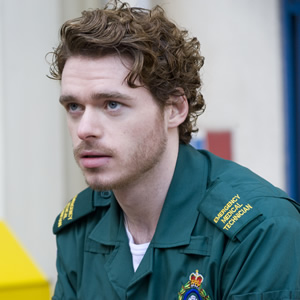
Last week we saw the series finale of Sirens, a channel 4 drama about the life of three paramedics.  It was an interesting and funny series, but not the main reason of this article though.

There's a gay character on the series: Ashley Greenwick, played by Richard Madden, who is what some will define as "straight acting", he is out, but not making a fuss out of it  Madden defines his character as a "gay man who isn't defined by his sexuality", adding that he was excited about that  "because I don't remember the last time we saw that on British TV. We don't really get to see gay characters who are completely open with their sexuality, but it doesn't define who they are."  Certainly he has a point in saying that we don't see much of those type of gay men on the media, nor here, nor in the US or other english speaking television or films, and I'm not only thinking on the over the top camp characters, but also the ones that even when not camp, their lives orbit around the scene and their sexuality (eg. Queer as Folk)

But is this a reflection of what is happening inside the gay culture as a whole?  I think it is.

In this country almost all the legal battles are won for gay people, granted, there's still a lot of homophobia in the society, and much work to be done in terms of sexual diversity acceptance, but now the work is down to communities, schools, educate people, since we have laws now that grant protection and rights for people who are not heterosexual.  Perhaps the only battle left is marriage equality, and the campaign Equal Love is fighting this on the European Court of Human Rights.

That has allowed many people, specially the young generation, to be open on their sexuality, yet living their lives without their sexuality being a central part of it or define who they are. There's no more need of being inside the ghetto and being overly flamboyant and camp to diferentiate yourself from the heterosexual men.

However, not everyone seems to be happy with this.  There has being lots of critics on the marriage equality campaign, surprisingly, coming from the gay community itself. The argument: it's a way to force assimilation into the hetero-normative society, and endangers the exciting, visionary, alternative culture that the gay culture represents, being marriage and monogamy a thing for "straight" people. This same criticism is targeted to the "straight acting" gay and bisexual men and women, who are accused of act as a heterosexual, for not conforming with the stereotypes (for some) or gay alternative cultural behaviour (for others)

For some, integration to the society and making sexuality just one of many things in your life is the goal, and an alternative culture is synonym of segregation; for others it's ok being immerse on the gay culture, where everything has to be gay (a gay house, a gay garden, gay music, etc.) and integration is saw as negative assimilation.

I wonder if we are going to be seeing these divisions grow, and these two types of LGBT people in divergent roads?

I think there's still the need of diversity friendly safe havens, as forums, as some gay bars and clubs and activities, but is the majority of people inside the LGBT community wanting to move forward to integration or want to retain their status as alternative and differentiated culture?

Who visits me

Locations of visitors to this page
eXTReMe Tracker