Thursday, 8 September 2011

Lists, lists, and more lists


I was reading a post from Carlos López (in Spanish) about how futile “favourite” lists can be on literature, even if it comes from a well known author or intellectual; arguing that literature taste is like football taste, totally subjective, and that each book touches each person in a different way.  I totally agree with that idea.  However it seems that more and more lists, not only on literature, but any other field you can imagine have been released over the internet or even books have been written about them.

Sergei Rachmaninov said that one life is not enough for all the music, but music is enough for one life. On the age of internet, there’s so much information floating around that it’s so difficult to keep track of the relevant stream, indeed one life is not enough, not just for music, but for the books, and all the knowledge we would like to have, so there’s a necessity of focusing our time on the information that is relevant to us.  Hence these lists are helpers on the “things to do” or “things to look at” for people.

There has being several on-going discussions on G+ about the list of recommended users to follow, sites like recommendedusers.com have tried to make unofficial lists, after the first google attempt of an “official recommendation” wasn’t that welcome.  I have been participating in several of these discussions, but one that made me think the most was one about Carter Gibson's post discussing the lack of sexuality on your about information, after this Ryan Crow expanded the debate, on a post of his own, to also political views and religion fields on G+ profiles. Do we really need them?  I argued in favour of those fields to be included, since there’s a real need of community build around sexuality, political views and even religion (or lack of it).  For mainstream people (ie. heterosexual, christian, capitalists) there’s no real problem, but to minorities this becomes more of an issue, you can see my comments on the thread for more about that, but a lot of comments of people who were against made me think.

Even in a small and emerging social network as Google Plus, with “only” 25 million users, there’s so many people there that it’s hard to find who to follow on it.  Ideally, we would go around and start following people based on their comments, and the things they share, people who we really find interesting.  Reality is that if we don’t narrow down the numbers, based on our interests, we would not have the time to do it, or just drift away in the flow of information without a set course.  So yes, we need those lists, and people like Alireza Yavari are doing a great job in putting them all together.

However, how healthy is this?.  A comment from a friend of mine on FB saying that she should know better than reading certain papers, is symptomatic of our days.  We only want to read and see things that we agree with, in a way reaffirming our thoughts and avoid confronting our point of view.  We seek for like-minded people and content only, that could lead us to just to alienate ourselves. 

This interesting video talks precisely about that:


It’s not just ourselves consciously putting filters on which type of content we want to see, or what kind of people we want to hear or read. Now even the search websites and social networks are putting in place algorithms to filter for us the information stream, leaving us, for all practical purposes, living in a bubble of information that, yes is the one we like, but making all the rest of it a black box to us.  Learning and growing as a person is not all about things you like or things you agree with, or things that went well in your life, it’s actually mainly about mistakes, confrontation of ideas, things that went wrong, that is what make us grow, that is what makes us learn.

There’s no use in just having information flowing in front of us that just make us shake our heads in agreement

It is in a way like the parents of these days who don’t want their children to be exposed to any bacteria at all, and keep everything crystal clean, living in almost an sterilized environment; and therefore those kids never develop the necessary antibodies.

We need exposure to all kind of ideas, not just the ones we like, but mainly the ones that are relevant, not only to us, but to the world we live.

So yes, it’s great to have a list of books you should read, a list of like-minded people you can follow, a list of your favourite papers and columnists.  But don’t limit yourself to only that, explore new avenues, read things that make you think, even that make you angry.  I will probably will keep using those kind of lists, since yes, we all need to narrow down what it seems to endless sources of information; but I would suggest, try now and again to just find things the old fashion way, without anyone telling you which way is the right one, just exploring.

Sunday, 4 September 2011

Does Sexuality needs scientific validation?


Science as any other tool can be used for political purposes.

In that sense several studies about gender, gender identification and diversity in sexuality have been circulating in scientific papers from researches and Universities.  Even when the scientific method is per se, objective, the way results or studies are presented can have a strong political agenda.

So we have lots of studies about gender differences, that to some extend have validated the idea that women and men are different in the way the think, feel and behave.  This has been reflected in popular culture, to give the masses the "scientific truth" that, to put it on the words of a popular book, women are from venus and men are from mars.   Problem is that the studies tend to confuse nature and nurture.  Is the way men and women react to stimuli different because the way they have being educated, or is it something that they are born with?   At least one study seems to think we are actually not that different, and I definitely recomend the reading of  Delusions of Gender: How Our Minds, Society and Neurosexism Create Difference.

Then it came to validate the notion that homosexuality is something people are born with, and not acquired. There was a very powerful reason behind these studies, and it is that the christian right wing insisted (and still does) that homosexuality was a deviation, a perversion that men and women choose to live against their god's teachings.  So various studies were made on the subject, and also in other species, to show that homosexuality was something natural.   How ever the inability of shown that there's a "gay gene" or something specific that triggers homosexuality when people are born, has being used as a weapon to say that as with gender, they studies can't give a conclusive truth about the nature vs nurture debate.

Finally just a few weeks ago, a new study was published, this time was about bisexual men, that branch of sexuality that is famous for it's partial invisibility and attacks from both heterosexual and homosexual communities that "doubt" that it really exists. So  this new study tend to conclude that yes, bisexuals are real.  But not much time passed for the study to start being attacked under the same premises.

Studies and counter studies can be made about gender and sexuality, all along, and change with the political tide that they surf with.  But the question will be:  Do we really need to validate our sexuality or our gender with scientific studies? or is it not a better long term solution to educate people on accepting that even in our differences we are all human and deserve respect, and that stereotypes are just product of ignorance?

I have no doubt that all this scientists have good intentions when they try to prove that men and women are equal, that gay, lesbians and bisexuals are not perverts, etc.  And yes, their work can be used to some extent. But science is useless against prejudice, ignorance and hard religious indoctrination. And some times even counter-productive.  The only thing that can really make a difference is education, in both our homes and schools.

- This post was originally written for Queer UK and appears here.

Saturday, 3 September 2011

Soundtrack music

This post is in response to NextManStanding post about soundtracks.

I will classify soundtrack music in three categories.

The First Category will be Soundtracks which aim to transmit a specific feeling or mood in general terms. Music born out of a theme or idea.  This music has its origins in academic music.

From Vivaldi's four seasons:


to Holst's Planets:


or the famous Musorgski/Ravel "pictures at an exhibition":


they are compositions that try to express a visual idea, in form of music.  If successful the composer would be able to transmit the basic emotions associated with the visual (or multi sensory input) theme they chose as inspiration.

This is one of my favourite genres of music, since I think it was the first multimedia works, and they obviously work as it even now a days.   A lot of my own music falls into this category, specially when inspired on the places I have visited. Here an example.


Obviously with the advent of films, this was the chosen style that film soundtrack composer have chosen to follow, and there are great composers indeed.  Hans Zimmer, John Williams, Michael Nyman, to name a few. We all have our favourites, and we all know film themes that are easy to distinguish and associate with the film itself, specially if it's a famous one.  TV series and Video Games, now a days, tend to fall also on this categories, with really interesting music made for those two.

I can think of two of my favourites:

Bear McCreary's Battlestar Gallactica music:


Final Fantasy Advent Children:


The second category will be the "jingle"  "intro" themes for commercials, telly series, video games, and to some extend some films.  They tend to be easy listening, rapid-catch themes, case in point this two:


Or "epic and very identifiable themes" like, arguably the most famous music intro to a film,  which most people would recognize.


Even when they have to be in-line with the general feeling of the visual media they are associated, they not necessarily try to express a specific image on the listener (a priori that is).

The third category, the songs that have become famous for a film, tv series, video game or even commercial.  They may or may not have being composed specifically for the visual media they are associated to, they usually aren't, but after the media exposition they have come to be one and the same with the show.  Eg.


My obvious favourite is category one, but there are some interesting things that I have come to love from category 3, and not that many but some specific examples in category 2

So, do you like more a category from another, why and which song/theme is your favourite?


Saturday, 13 August 2011

Integration or non-desired assimilation?

Last week we saw the series finale of Sirens, a channel 4 drama about the life of three paramedics.  It was an interesting and funny series, but not the main reason of this article though.

There's a gay character on the series: Ashley Greenwick, played by Richard Madden, who is what some will define as "straight acting", he is out, but not making a fuss out of it  Madden defines his character as a "gay man who isn't defined by his sexuality", adding that he was excited about that  "because I don't remember the last time we saw that on British TV. We don't really get to see gay characters who are completely open with their sexuality, but it doesn't define who they are."  Certainly he has a point in saying that we don't see much of those type of gay men on the media, nor here, nor in the US or other english speaking television or films, and I'm not only thinking on the over the top camp characters, but also the ones that even when not camp, their lives orbit around the scene and their sexuality (eg. Queer as Folk)

But is this a reflection of what is happening inside the gay culture as a whole?  I think it is.

In this country almost all the legal battles are won for gay people, granted, there's still a lot of homophobia in the society, and much work to be done in terms of sexual diversity acceptance, but now the work is down to communities, schools, educate people, since we have laws now that grant protection and rights for people who are not heterosexual.  Perhaps the only battle left is marriage equality, and the campaign Equal Love is fighting this on the European Court of Human Rights.

That has allowed many people, specially the young generation, to be open on their sexuality, yet living their lives without their sexuality being a central part of it or define who they are. There's no more need of being inside the ghetto and being overly flamboyant and camp to diferentiate yourself from the heterosexual men.

However, not everyone seems to be happy with this.  There has being lots of critics on the marriage equality campaign, surprisingly, coming from the gay community itself. The argument: it's a way to force assimilation into the hetero-normative society, and endangers the exciting, visionary, alternative culture that the gay culture represents, being marriage and monogamy a thing for "straight" people. This same criticism is targeted to the "straight acting" gay and bisexual men and women, who are accused of act as a heterosexual, for not conforming with the stereotypes (for some) or gay alternative cultural behaviour (for others)

For some, integration to the society and making sexuality just one of many things in your life is the goal, and an alternative culture is synonym of segregation; for others it's ok being immerse on the gay culture, where everything has to be gay (a gay house, a gay garden, gay music, etc.) and integration is saw as negative assimilation.

I wonder if we are going to be seeing these divisions grow, and these two types of LGBT people in divergent roads?

I think there's still the need of diversity friendly safe havens, as forums, as some gay bars and clubs and activities, but is the majority of people inside the LGBT community wanting to move forward to integration or want to retain their status as alternative and differentiated culture?

Friday, 12 August 2011

England in chaos

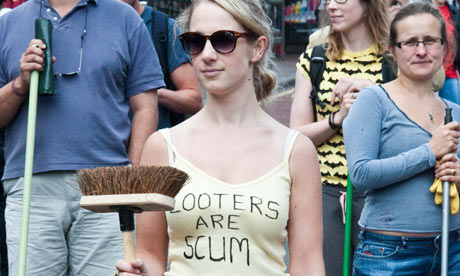
The riots that happened across England in the past days have dominated the media, news, blogs, forums, and people all over are taking about it, and first I thought it would be a little redundant to write a blog entry about it, but I decided to do it since I see that there's no much talking about the root causes of them, seems that both the people and the government have decided to go for simplistic explanations.

I'm not expert, nor a sociologist, but I do understand that a social unrest of this magnitude is much more complex than just "pure criminality due to bad parenting" as Mr. Cameron seems to have concluded.  The right wing position seems to be very simple, it has nothing to do with poverty, it has nothing to do with social inequality, it's all just to blame to parents who didn't teach their children what's good and what's wrong and reduce them to a state of wild beasts, they are less than humans, they are just greedy animals and criminals.

We have seen thousands of people, most of them youngsters (but not all), who have lost respect, not for the government and police, which are there not to cause respect, but to serve people; they have lost respect for their communities, they don't care to loot a small shop, if they can get alcohol and fags, they don't care to set buildings in fire, they are totally alienated from the rest of the British society, but why?

The most alarming thing is not just that, since it's not unexpected to have that reaction from the right wing, the alarming thing is that a wider part of society, even if they are not firmly right wing supporters, is agreeing with that, going for the simplistic answer.  It is much more easy to just blame the parents and forget about that, arrest the looters, send them to jail, charge the parents when the looter is too young for a sentence, and that's it, problem solved.


Which are the reasons then?

Well, I'm sure there are even more, but I can identify some:

1) Social inequality. The UK is the country with the worst social mobility in the developed world, and the second (after the US) of socio-economic disparity (difference between the richer and poorer)


2) Social expending and lack of opportunities. Beginning with Tattcher’s destruction of the UK Industry, and her social cuts, passing from Labour inefficiency to solve things for the bottom part of society and ending with more cuts of the current government. It's no surprise that if you take away the last little things that gave people hope, the benefits, the jobs, the possibility of higher education, the support structures, you are hitting both psychologically and economically to the marginalized part of the society, sending a message that they have no future, nor hope of getting out of their circumstances, they are worthless and nobody cares about them, so they have nothing more to lose.
3) The consumerism culture. You are the goods you have in this society, people are no longer aspiring to have a good education, but just the more money and goods they can, and now, quickly, and don’t forget to renew them ASAP. That affects all levels of society, difference is that in people who can’t really access those goods, only causes frustration.  The looters are not starving, let's face it there's not that level of poverty in the first world like in the third world, but they are conditioned to the social "truth" that if you don't have the latest clothes gadgets and technology you're worthless.


4) Parenting and school system lack of discipline. It is also true, that first teachers and now even parents are afraid to control and teach discipline, and this is happening in all levels of society, is not only absent parents, is also parents dropping all the responsibility of education to schools and schools not having the means to enforce discipline. It's broken families on which their children see as the only exit the gang culture, and the only respect and sense of community found inside their gangs. 


5)Racial and Police violence. In the marginalized places of society there has being constant and systematic violence, even racist institutionalized policies. This point is one of the more complex and also more sensitive.


Also, how much does it contribute that we all have seeing MPs making fraud on their expenses and not being punished, corruption on the police on the phone hacking scandal, bankers getting big bonuses even when they basically caused the global crisis.  How all this people are expected to be "responsible for their acts" when we don't see any of that responsibility on the top part of our leaders and representatives?


How can they feel comfortable when they smash in their faces the wedding of two millionaires, one of them born with privileges not only of money, but socially being above the law,  and say that that's the thing that should make them be proud of being British.  Or saying that there's social cuts necessity and at the same time spending millions in foreign wars?


Now that the riots seem to be calmed down it's time for the aftermath. 


What is next?


The government and the society in general have two options, as far as I can see.

1) Ignore the root causes and impose draconian measures, enforcing a police state, limiting privacy and comunication on social media; giving more power to the police, and not caring about "phoney human rights concerns". Taking out all benefits from the rioters, evicting rioters from their houses and jail them, and then turn the page. Sadly for what Cameron has speak in the Commons, this seems to be his course of action.


2) Understand why this hapenned, understanding is NOT justifying, let´s be clear, what this people did was wrong, it was a criminal activity and it affected inocent people on their businesses and houses.  But if we fail to understand why this happened then we will see happening again in the future.  If we as a society and the government as the executive power identify the causes, then we can work in trying to fix them and make something like this less unlikely to happen in the future.

Who visits me

Locations of visitors to this page
eXTReMe Tracker